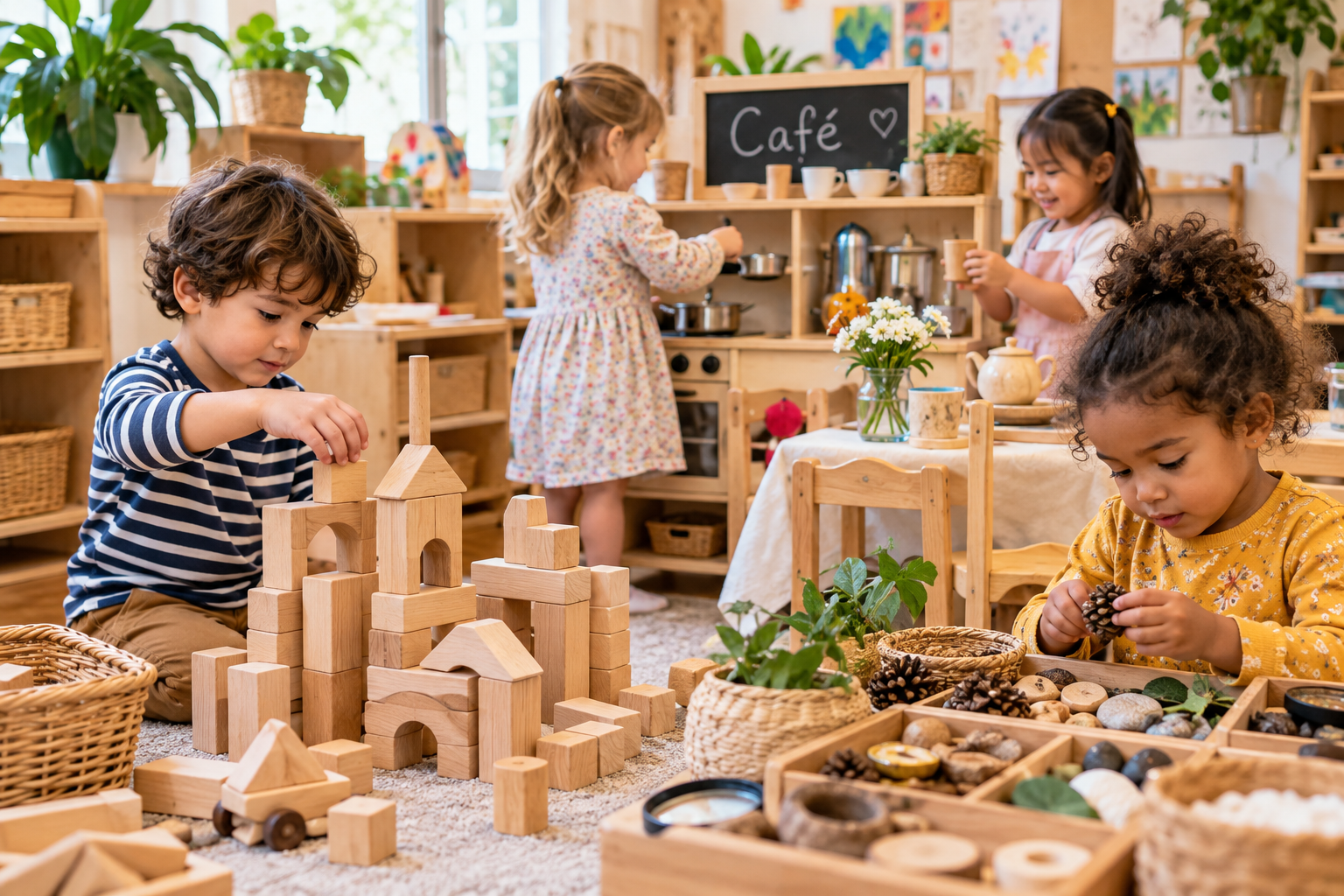
Sometimes the busiest learning in a preschool classroom doesn’t look much like a lesson at all.
A child is building a tower and trying again every time it falls.
Two children are negotiating who gets to be the doctor.
Someone is filling the same container with sand over and over again.
Another child has turned a cardboard box into a bus, a house and—somehow—a dinosaur.
It can look like they’re “just playing.”
But look a little closer and you’ll often find problem-solving, language, mathematical thinking, creativity, cooperation, persistence and plenty of experimentation happening underneath.
That’s what makes play-based learning in preschool so powerful.
Play-based learning gives children opportunities to explore ideas through meaningful, enjoyable experiences while teachers thoughtfully create environments, observe children’s interests and extend learning when appropriate.
And importantly, play-based learning doesn’t mean teachers simply put out some toys and hope learning happens.
Our role still matters.
Here are 7 simple ways teachers can support play-based learning in preschool without taking over children’s play.
Affiliate Disclosure: As an Amazon Associate, I earn from qualifying purchases. This means I may earn a small commission if you purchase through links on this page, at no additional cost to you.
What Is Play-Based Learning?
Play-based learning is an approach where children actively explore, experiment, make choices, solve problems and build understanding through play.
Sometimes that play is completely child-directed.
Sometimes teachers intentionally prepare an environment or introduce particular materials.
And sometimes we join the play, ask a thoughtful question, introduce new vocabulary or add something that extends children’s thinking.
There isn’t necessarily a battle between play and teaching.
NAEYC describes playful learning as including free play, guided play and games. Guided play preserves children’s agency while allowing educators to intentionally support learning goals. NAEYC
That’s an important distinction.
We don’t have to choose between:
“Children should be completely left alone.”
and
“Teachers should direct everything.”
Good early childhood teaching can sit somewhere in between.
1. Give Children Enough Time to Actually Play
One of the simplest ways to support play-based learning is also one of the easiest to overlook:
Give play time.
Imagine a group of children building an elaborate block structure.
They’re deciding where pieces belong, solving stability problems and beginning to create a story around what they’ve built.
Then:
“Okay everyone, tidy-up time!”
Sometimes transitions are unavoidable.
But when children’s play is constantly interrupted, they have fewer opportunities to develop their ideas.
Meaningful play often needs time to become complex.
Where possible, protect periods of uninterrupted play and notice when children are deeply engaged before automatically moving everyone to the next activity.
NAEYC recommends sustained daily opportunities for play both indoors and outdoors. NAEYC
Teacher tip: If a play experience is going particularly well, ask yourself whether it really needs to end—or whether your plan can bend a little.
2. Create an Environment That Invites Exploration
You don’t need the most beautiful classroom on Pinterest.
You need a classroom children can use.
Think about whether children can independently reach materials, see what is available and make choices about their play.
Simple materials can offer enormous possibilities:
blocks, baskets, containers, fabric, loose parts, pretend-play props, art materials, puzzles and natural objects.

Instead of filling every shelf, try offering a thoughtful selection of materials with enough space for children to explore them.
The environment itself can become part of our teaching.
NAEYC’s developmentally appropriate practice guidance encourages educators to plan environments that support children’s choices while using observations of their play to decide which materials and resources to offer next. NAEYC
And sometimes removing something is just as useful as adding something.
Open-ended art can be part of this environment too. If you’re looking for ideas, explore these 7 Process Art Ideas for Preschool.
3. Follow Children’s Interests
Children are very good at showing us what they’re interested in.
We just have to notice.
Maybe several children have started looking for insects outside.
Perhaps every block construction suddenly becomes a road.
Maybe dinosaurs have taken over the entire classroom.
Rather than immediately planning an unrelated teacher activity, consider how you could extend what is already capturing their attention.
If children are interested in roads and vehicles, you might add:
road signs, maps, clipboards, measuring tapes, cardboard tubes or different types of vehicles.
Then observe what happens.
Following children’s interests doesn’t mean we abandon intentional teaching.
It means we use their curiosity as a doorway into deeper learning.
Sensory play can also be a simple way to build on children’s interests. You might like these 7 Easy Sensory Activities for Preschool for more hands-on ideas.
4. Ask Questions Without Taking Over
Questions can extend children’s thinking—but too many questions can turn play into an interview.
Instead of constantly asking:
“What colour is that?”
“How many blocks do you have?”
“What’s this called?”
try occasionally using questions that invite thinking:
“What do you think might happen if…?”
“How could we make it taller?”
“I wonder what else we could use?”
Sometimes you don’t need a question at all.
A simple observation can be enough:
“You’ve been working on that for a long time.”
or
“I noticed the tower kept falling and you changed the bottom.”
In guided play, teachers can use comments, suggestions and questions to extend children’s thinking while children remain active participants in the experience. NAEYC
And sometimes the best teaching decision is simply to watch.
5. Add Materials That Extend the Play
You don’t always need to create a brand-new activity.
Sometimes one new material is enough.
Imagine children repeatedly pretending to run a café.
Tomorrow, you might add:
a notepad, pencils, menus, empty food containers or a simple cash register.

Suddenly the same play could include early writing, number language, turn-taking, communication and problem-solving.
Or perhaps children are building towers.
Try adding photographs of buildings, measuring tapes or different construction materials.
The goal isn’t to steer children toward a predetermined result.
We’re simply giving their ideas somewhere else to go.
Extend the play: If your dramatic-play area doesn’t already have one, a simple pretend-play cash register can be a useful addition for café, shop and restaurant play. Children can take turns being the customer and cashier while naturally exploring number language, pretend money and everyday social interactions.
6. Join the Play—But Don’t Become the Boss
Sometimes children invite us in.
That’s a wonderful opportunity.
If you’re handed an imaginary cup of tea, drink it.
If you’ve been assigned the role of patient, apparently you’re going to the doctor.
But notice what happens when you enter.
Are you following the children’s story?
Or have you accidentally taken control of it?
Instead of:
“Okay, now let’s make the café and you can be the chef.”
try:
“Who am I?”
or
“What should I do?”
That small difference keeps children in charge of the direction while still allowing us to participate and introduce language, ideas or gentle challenges when appropriate.
Playful learning works particularly well when children remain active explorers rather than becoming passive recipients of adult instructions. NAEYC
7. Observe the Learning That’s Already Happening
Sometimes we rush to add learning to play because we haven’t stopped to notice what’s already there.
Watch children building with blocks.

You may see:
Maths: size, shape, quantity, balance and measurement.
Language: explaining ideas, negotiating roles and learning new words.
Social development: sharing space, cooperating and resolving disagreements.
Physical development: carrying, stacking, manipulating and positioning materials.
Thinking skills: predicting, testing, adjusting and solving problems.
Creativity: imagining, representing and transforming ideas.
Play supports development across language, cognition, social competence, self-regulation and physical development, while also allowing children to explore and make sense of their world. NAEYC
Before adding another activity, worksheet or teacher instruction, ask:
What are the children already learning here?
You might discover that quite a lot is happening.
Play-Based Learning Doesn’t Mean “Anything Goes”
This is an important misconception.
A play-based classroom isn’t necessarily a classroom where children simply do whatever they want all day while teachers stand back.
Teachers still:
prepare environments intentionally,
build secure relationships,
observe,
introduce materials,
model language,
support social interactions,
help children regulate emotions,
notice emerging interests,
extend thinking,
and plan what might come next.
High-quality early childhood practice includes a balance of child-led and teacher-scaffolded opportunities rather than relying exclusively on either completely free play or direct instruction. NAEYC
Our teaching can be intentional without controlling every experience.
A Quick Play-Based Learning Check
When you’re looking around your classroom, try asking yourself:
☐ Do children have meaningful choices?
☐ Can they access and use materials independently?
☐ Do they have enough uninterrupted time to develop their play?
☐ Am I observing before stepping in?
☐ Are my questions extending thinking rather than testing children?
☐ Can children’s interests influence what we offer next?
☐ Am I supporting the play—or accidentally directing it?
You don’t need to tick every box during every experience.
It’s simply a useful reminder that play-based learning is not about creating elaborate activities.
It’s about creating the conditions for meaningful play and knowing when—and how—to support it.
It’s Not “Just Play”
When a child spends twenty minutes trying to build a bridge, they’re not wasting time before the “real learning” starts.
The learning is already happening.
When children negotiate roles in dramatic play, experiment with water, construct with blocks, create with art materials or investigate something they discovered outside, they’re developing ideas about themselves, other people and the world around them.
Research and professional early-childhood guidance consistently connect play with learning and development, including language, problem-solving, social competence and self-regulation. NAEYC
Our job isn’t to turn every moment of play into a lesson.
Sometimes our job is to prepare thoughtfully, watch carefully, respond intentionally—and give children enough space to surprise us.
Looking for More Preschool Teaching Ideas?
Play-based learning doesn’t require elaborate activities or expensive classroom setups. Often, the most meaningful learning begins with time, thoughtful materials and a teacher who knows when to step in—and when to observe.
If you’d like another practical example of child-led learning, explore 7 Process Art Ideas for Preschool and discover simple ways to encourage creativity, experimentation and children’s own ideas.
Leave a Reply