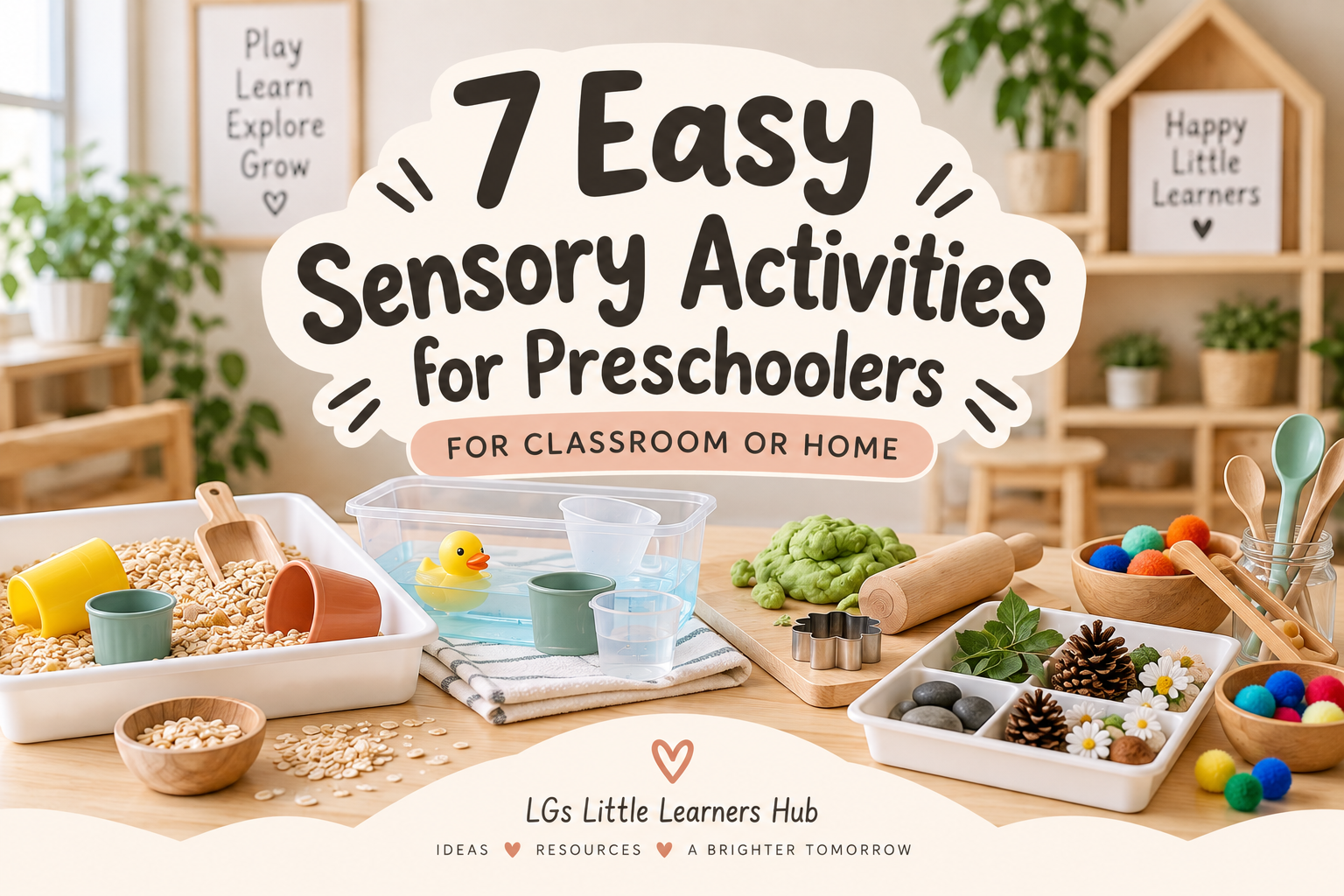
Sensory activities for preschoolers don’t have to involve complicated setups, expensive materials, or a huge mess. Some of the most engaging sensory experiences can be created with simple things you may already have in your classroom or home.
As an early childhood educator and a mum, I love activities that are easy to prepare but still give children plenty of opportunities to explore. Sensory play can encourage children to touch, pour, squeeze, scoop, sort, create, and investigate while developing important skills through play.
Here are seven easy sensory activities for preschoolers that can work in an early childhood classroom or at home.
Disclosure: This post may contain affiliate links. As an Amazon Associate, I earn from qualifying purchases at no extra cost to you.
1. Scoop and Pour Sensory Bin
A simple scoop-and-pour bin is one of the easiest sensory activities to set up and can keep children engaged in repeated exploration.
Fill a large container or tray with a suitable dry material such as oats or pasta. Add a few cups, scoops and small containers, then allow children to explore in their own way.
They might fill one container and empty it into another, experiment with different-sized scoops, or simply enjoy watching the materials fall.
What children can explore
- Scooping and pouring
- Hand-eye coordination
- Fine-motor control
- Concepts such as full and empty, more and less
- Independent exploration
Teacher & Mum Tip: Place the sensory container inside a larger tray or on a mat. It won’t catch everything, but it can make cleanup much easier!
Helpful tool: If you’d like a reusable set for sensory play, the Learning Resources Helping Hands Fine Motor Tool Set includes tools children can use for scooping, transferring and fine-motor exploration.
For younger children, always choose materials that are appropriate for their age and stage of development and supervise sensory play closely.
2. Water Transfer Play
You really don’t need much to create an engaging water-play experience.
Add a small amount of water to a shallow container and provide cups, bowls, spoons, funnels or small jugs. Children can practise transferring the water from one container to another and experiment with what happens when they pour at different speeds.
It’s a very simple activity, but there is a lot of learning happening as children repeat the same actions.
What children can explore
- Pouring and transferring
- Hand-eye coordination
- Cause and effect
- Early ideas about capacity
- Concentration and persistence
Teacher & Mum Tip: Start with less water than you think you need. Children can still have a meaningful sensory experience with a small amount of water—and there will be much less to clean up afterward.

3. Playdough Sensory Invitation
Playdough is one of those resources that can be used again and again in different ways.
Set out some playdough with a small selection of tools such as rollers, cutters and child-safe utensils. Depending on the children’s ages, you could also introduce suitable natural or loose materials for them to press, arrange and explore.
Instead of showing children exactly what they should make, give them time to experiment. They may squeeze the dough, roll it, flatten it, make marks or create something completely unexpected.
What children can explore
- Hand and finger strength
- Fine-motor control
- Creativity
- Texture and pressure
- Imaginative play
Teacher & Mum Tip: You don’t need to put every playdough tool you own on the table. I often find that offering just a few thoughtfully chosen materials creates a calmer setup and gives children more space to explore.
4. Nature Sensory Tray
Sensory activities don’t always need special sensory materials. Nature already gives us plenty to investigate.
Collect a few safe natural items such as leaves, flowers, smooth stones or pinecones and arrange them on a shallow tray. Children can touch, compare, sort and examine the different objects.
You can also introduce simple descriptive language while exploring together.
Try questions such as:
What does this one feel like?
Can you find something smooth?
Which one feels rough?
What do you notice about this leaf?
What children can explore
- Different textures
- Observation and curiosity
- Descriptive language
- Sorting and comparing
- Early science concepts
Teacher & Mum Tip: The activity doesn’t need to be beautifully arranged to be valuable. Even a small basket of interesting things collected during a walk can become a meaningful sensory experience.

5. Colour Sorting Sensory Play
Colour sorting combines sensory exploration with an easy early-learning activity.
Choose a small collection of coloured objects that are safe and appropriate for the children’s age. Add matching bowls or containers and, for older preschoolers, tongs or scoops for transferring the objects.
Children can sort the objects by colour, move them between containers or create their own groups.
What children can explore
- Colour recognition
- Sorting and classification
- Fine-motor control
- Hand-eye coordination
- Early mathematical thinking
Teacher & Mum Tip: Start simply. Two colours can be enough for a younger child. You can gradually introduce more as they become familiar with the activity.
6. Wash-the-Toys Sensory Play
This is one of my favourite examples of how everyday experiences can become meaningful play.
Place some washable toys in a container with a small amount of warm water. Add a sponge, cloth or small brush and let the children wash, scrub, rinse and dry the toys.
It feels like play to children, but it also introduces an everyday practical-life experience.
You could use toy animals, pretend-play dishes or other washable classroom or home resources.
What children can explore
- Water and texture
- Scrubbing and squeezing
- Hand-eye coordination
- Practical-life skills
- Independence
- Imaginative play
Teacher & Mum Tip: You don’t always need to create something new. Sometimes changing the way children interact with familiar toys is enough to make an activity interesting again.

7. Simple Sensory Discovery Tray
For the final activity, keep things completely open-ended.
Choose a few objects with noticeably different textures and place them on a shallow tray. You might include a piece of soft fabric, a sponge, a wooden object, a textured ball or a brush.
Rather than asking children to complete a particular task, allow them to investigate the materials freely.
Some children may touch everything immediately. Others may spend several minutes investigating just one object. Both are completely valid ways to explore.
What children can explore
- Different textures
- Sensory discrimination
- Curiosity
- Descriptive language
- Independent decision-making
Teacher & Mum Tip: Instead of replacing the entire tray every time, change just one or two materials. A small change can make a familiar activity feel interesting again.
How to Make Sensory Play Easier for Adults Too
Sensory play is wonderful for children, but it also needs to be realistic for the adults preparing and cleaning up the activity.
A few simple habits can make sensory activities much easier to manage:
- Start small. You don’t need to fill an entire sensory table.
- Use trays or mats. They can help contain materials and define the play space.
- Choose reusable materials. Cups, scoops, bowls and washable tools can be used across many different activities.
- Keep the setup simple. More materials don’t automatically mean better play.
- Follow the child’s interest. Sensory play doesn’t always need a specific finished product or outcome.
Most importantly, consider the individual children taking part. Materials should always be appropriate for their age and developmental stage, and children should be actively supervised—particularly when activities include water, small objects or loose materials.
You Don’t Need a Perfect Sensory Setup
It’s easy to look at beautiful sensory activities online and feel like you need lots of special materials to recreate them. You don’t.
A bowl of water with a couple of cups, some playdough and a roller, or a collection of leaves from outside can provide meaningful opportunities for children to explore.
For me, the best sensory activities are the ones that are simple enough to actually use.
Start with what you already have. Keep the setup manageable. Then give children the time and freedom to touch, experiment, repeat and discover in their own way.
That’s often where the best learning happens.
Looking for more practical early learning ideas? Explore more ideas on the LGs Little Learners Hub Blog.
Leave a Reply