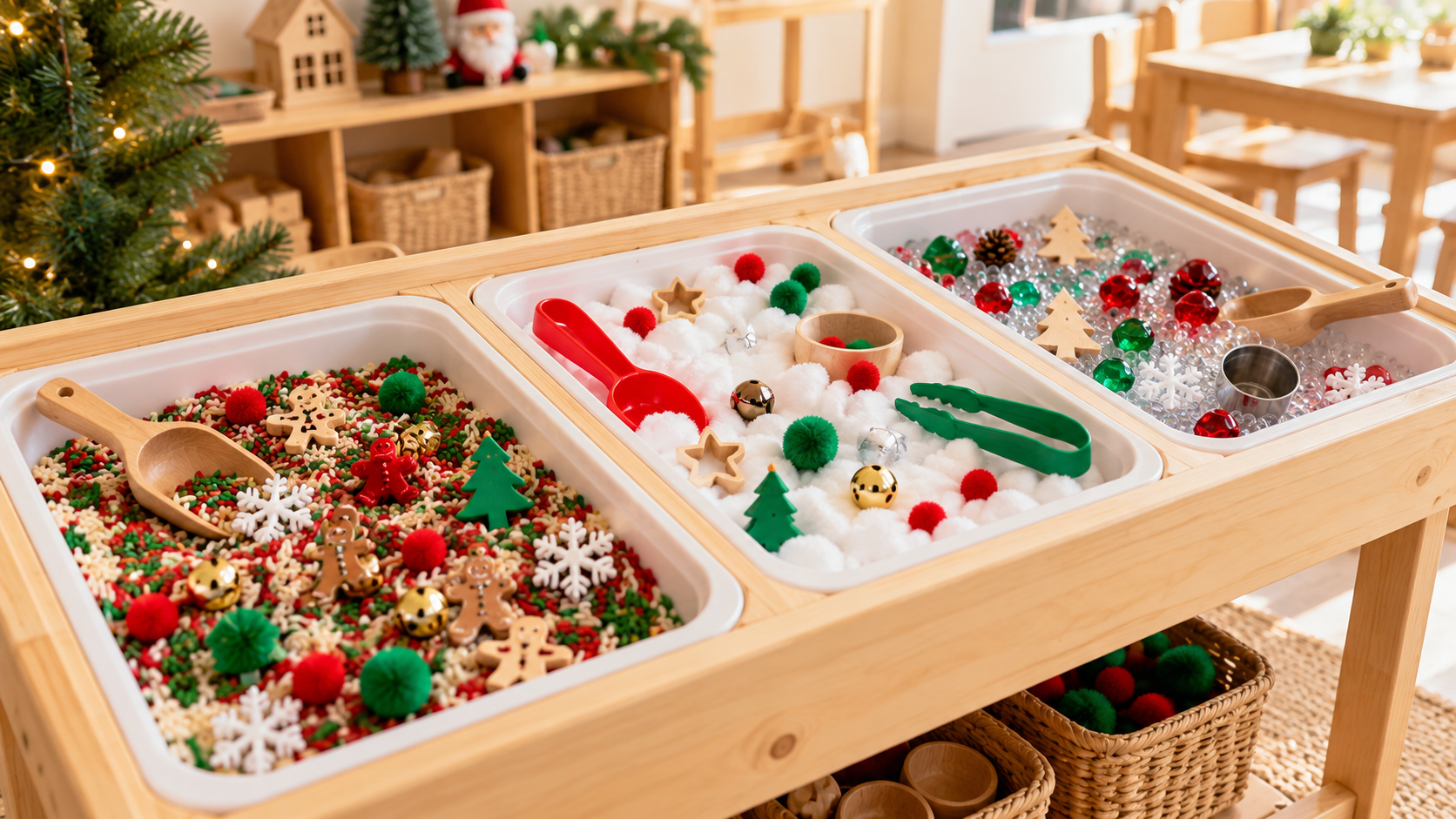
Christmas is such a fun time to bring a little extra magic into the preschool classroom—but you don’t need complicated activities or a cupboard full of new supplies.
These Christmas sensory activities for preschool are simple, hands-on ideas that children can explore through scooping, sorting, pouring, counting, creating and playing. Many use materials you may already have in your classroom, and each activity can be adapted to suit the children in your group.
Below you’ll find 10 easy Christmas sensory activities that support fine-motor development, early maths, creativity and open-ended exploration—without needing to create a Pinterest-perfect setup every time.
Teacher tip: You don’t need every material shown in these activities. Start with what you already have and adapt each idea to your children, your space and the resources available in your classroom.
Setting Up a Simple Christmas Sensory Area
Before we get into the activities, it helps to have one simple sensory area that you can change throughout the Christmas season.
You don’t need a dedicated sensory table. A shallow tray, storage container or large plastic tub placed on a child-height table can work perfectly well.
If sensory play is something you use regularly in your classroom, a dedicated sensory table can make changing activities easier.
Optional classroom resource:
VEVOR Sensory Table for Toddlers and Kids
If you use sensory play regularly, this child-height table gives you three removable bins for setting up different materials or activities. I especially like that it isn’t Christmas-specific—you can reuse the same table for sensory play throughout the year.
→ See the VEVOR Sensory Table on Amazon
You absolutely don’t need a dedicated sensory table to try the activities below. A shallow tray, storage container or large plastic tub on a child-height surface can work just as well.
As an Amazon Associate, I earn from qualifying purchases at no additional cost to you.
Again, this is completely optional. You can recreate every idea in this post using ordinary trays and containers you already have.
Now, let’s play!
1. Christmas Pom-Pom Scoop and Sort
This is one of the easiest Christmas sensory activities to put together, but there are so many ways children can explore it.
Fill a sensory tray or shallow container with red, green and white pom-poms. Add a few small bowls or containers along with child-friendly tongs, scoops or grabbers.
Then simply invite the children to explore.
Some children may enjoy transferring the pom-poms from one container to another. Others may naturally begin sorting them by colour or size. Older preschoolers can count how many they have collected or try making simple colour patterns.
What you’ll need
- Red, green and white pom-poms
- Sensory tray or shallow container
- Small bowls or cups
- Scoops, tongs or grabbers
What children are learning
As children squeeze the tongs, pick up pom-poms and transfer them between containers, they are strengthening the small muscles in their hands and developing hand-eye coordination and fine-motor control.
Sorting the pom-poms can also introduce early mathematical ideas such as colour recognition, grouping, comparing, counting and patterning.
Make it easier—or add a challenge
For children who are still developing their fine-motor control, offer a larger scoop or let them use their hands.
For children ready for more challenge, add number cards and invite them to place a matching number of pom-poms into each bowl, or begin a simple red-green-red-green pattern for them to continue.

2. Jingle Bell Transfer Station
There is something about jingle bells that immediately makes an activity feel like Christmas.
Place a selection of bells in a sensory tray and provide small containers and tools for transferring them.
Children can scoop, pick up, move and drop the bells into different containers. As they play, they’ll also discover what happens when the bells are shaken, dropped or moved together.
That little bit of sound adds another sensory element to the experience.
What you’ll need
- Age-appropriate jingle bells
- Small containers
- Scoops or tongs
- Sensory tray
What children are learning
This simple activity supports fine-motor coordination, concentration and cause-and-effect exploration.
You can also introduce early maths naturally by talking about quantity:
“Which bowl has more?”
“How many bells did you collect?”
“Can you find three bells?”
There’s no need to turn the activity into a lesson. These little questions can simply become part of the conversation while children play.
Make it easier—or add a challenge
Let children transfer the bells using their hands first before introducing tools.
For older preschoolers, add numbered containers and encourage them to place the corresponding number of bells inside.

3. Christmas I-Spy Sensory Bin
Turn your Christmas sensory bin into a simple treasure hunt.
Choose a sensory base and hide several Christmas-themed objects inside. Children can dig, scoop and search to discover what is hiding underneath.
You could hide objects such as large Christmas ornaments, felt shapes, bells, mini gift boxes or other age-appropriate Christmas pieces.
What you’ll need
- Sensory base
- Christmas-themed objects
- Scoops or small containers
- Sensory tray or bin
What children are learning
Searching for hidden objects encourages visual discrimination, concentration, problem-solving and language development.
Use the discoveries to encourage conversation:
“You found a Christmas tree!”
“What colour is it?”
“What else can you find?”
You could also photograph the objects before hiding them and create a simple visual checklist for children who enjoy matching and searching.
Keep it open-ended
You don’t always need an I-Spy list.
Sometimes hiding a few interesting objects and allowing children to discover them independently creates richer conversations and imaginative play.

4. Fill the Christmas Stocking
This is a simple way to combine Christmas sensory play with early counting.
Place small Christmas stockings or stocking-shaped containers beside your sensory materials. Children can scoop or pick up objects and place them inside.
For younger preschoolers, simply filling and emptying the stockings can be the activity.
For children ready for more mathematical thinking, add number cards.
A child who chooses the number 5, for example, can try placing five objects into their stocking.
What you’ll need
- Small Christmas stockings or containers
- Pom-poms, bells or other manipulatives
- Tongs or scoops
- Number cards if desired
What children are learning
Filling and emptying containers supports children’s understanding of space, quantity and capacity, while adding numbers introduces counting and one-to-one correspondence.
Children are also developing hand strength and coordination as they manipulate the materials.
Teacher tip
Let children decide how they want to play before introducing the counting challenge. Not every sensory activity needs an adult-directed outcome from the beginning.

5. Gingerbread Sensory Dough Invitation
Christmas sensory play doesn’t have to happen inside a sensory bin.
A gingerbread-inspired playdough invitation can be a wonderful change of texture while still supporting open-ended exploration.
Prepare your usual classroom playdough and add gingerbread-inspired colours or scents if appropriate for your setting. Add rolling pins, child-safe cutters and a few loose parts for decorating.
Children can roll, press, squeeze, cut and create their own gingerbread shapes.
What you’ll need
- Playdough
- Rolling pins
- Gingerbread or Christmas cutters
- Loose parts for decorating
- Small trays
What children are learning
Manipulating playdough is wonderful for strengthening the hands and fingers children will later use for drawing, writing, fastening clothing and using tools.
It also encourages creativity, symbolic thinking and language.
You may hear children creating gingerbread families, Christmas cookies, houses or entirely different creations.
Let their ideas lead the play.

6. Decorate a Sensory Christmas Tree
Instead of making a Christmas tree craft where every child’s finished piece looks the same, try turning it into an activity children can change again and again.
Create a simple reusable Christmas-tree shape using felt, cardboard or another sturdy classroom material.
Place it beside a tray containing large pom-poms, ribbons, felt shapes or other suitable loose parts.
Children can decorate the tree, remove everything and start again.
What you’ll need
- Reusable Christmas-tree shape
- Large pom-poms
- Felt pieces
- Ribbon or other suitable loose parts
- Tray or shallow container
What children are learning
Children practise fine-motor control, spatial awareness, decision-making and creativity as they decide where each decoration belongs.
There is also no “correct” Christmas tree.
One child might carefully create a pattern. Another might place everything in one area. Another might use the materials to invent something completely different.
That’s part of the learning.

7. Christmas Scoop, Pour and Fill Station
Sometimes the simplest sensory experiences are the ones children return to again and again.
Fill a sensory tray with an appropriate sensory base and provide containers of different sizes, scoops and funnels.
Add a few Christmas colours or objects to connect the activity to the season.
Then let the children scoop, pour, fill, empty and repeat.
What you’ll need
- Sensory base
- Scoops
- Funnels
- Cups or small containers
- A few Christmas-themed additions
What children are learning
Pouring and filling helps children explore early concepts of capacity, volume, cause and effect, and comparison.
You can introduce mathematical language naturally:
“Your cup is full.”
“This one is empty.”
“Which container holds more?”
“It’s overflowing!”
These everyday conversations are often where some of the richest early maths learning happens.

Helpful Fine-Motor Tools for Sensory Play
You don’t need special tools for sensory play—kitchen scoops, spoons and small containers you already have can work perfectly well.
If you create sensory and fine-motor invitations regularly, the Learning Resources Helping Hands Fine Motor Tool Set is a useful reusable option. The four tools encourage different hand movements as children squeeze, grab, scoop and transfer materials.
Because the tools aren’t Christmas-specific, you can reuse them throughout the year for sensory bins, sorting activities, water play and other fine-motor experiences.
→ See the Helping Hands Fine Motor Tool Set on Amazon
8. Christmas Colour-Sorting Sensory Bin
Red, green and white materials make an easy Christmas sorting invitation.
Place mixed materials into one sensory bin and add three containers nearby.
You can use coloured bowls or simply add a coloured piece of paper underneath each container to provide a visual cue.
Children can then decide where each object belongs.
What you’ll need
- Red, green and white sensory materials
- Three bowls or containers
- Tongs or scoops
- Sensory tray
What children are learning
Sorting helps children notice similarities and differences, which is an important early mathematical thinking skill.
Children are also learning that objects can be classified according to different attributes.
And they may surprise you.
You might expect them to sort by colour while they decide to sort by size, texture or object type instead.
When that happens, ask them about their thinking rather than immediately correcting them.

9. Christmas Pattern-Making Sensory Tray
For children beginning to notice patterns, use your Christmas sensory materials to create a simple patterning invitation.
Start a pattern using two types or colours of objects:
🔴 🟢 🔴 🟢 🔴 …
Then see what the child decides to do next.
You could later explore:
AB: red, green, red, green
AAB: red, red, green
ABB: red, green, green
What you’ll need
- Two or three types of Christmas sensory materials
- Flat tray or work surface
- Optional pattern cards
What children are learning
Patterning supports early mathematical thinking by helping children notice sequence, repetition, prediction and relationships.
But keep this invitation playful.
Children don’t need to complete a pattern before they’re allowed to explore the materials in another way.

10. Open-Ended Christmas Sensory Bin
For our final activity, take away the instructions.
Really.
Place a thoughtfully chosen selection of Christmas-inspired materials in your sensory area along with a few containers and tools.
Then let the children decide what happens.
They might sort.
They might scoop.
They might create pretend Christmas food.
They might hide objects.
They might fill containers.
They might invent a story you never expected.
What you’ll need
Use whatever is suitable and available in your classroom. For example:
- Pom-poms
- Felt Christmas shapes
- Large bells
- Pinecones
- Ribbon
- Cups
- Bowls
- Scoops
- Tongs
- Christmas-themed loose parts
Why open-ended sensory play matters
When we give children time to explore without telling them exactly what the finished result should look like, we create opportunities for curiosity, creativity, problem-solving, communication and independent thinking.
Watch what children do before deciding what you need to teach next.
Sometimes the best extension comes from something a child has already started.

An Easy Option for Christmas Sensory Bin Fillers
If you don’t already have suitable Christmas-themed materials, a sensory-bin filler set can make this activity quicker to prepare. This Christmas set includes red, green and white pom-poms along with small seasonal pieces that children can sort, transfer and explore.
You can also reuse the pieces for several of the Christmas sensory activities above rather than creating a completely new bin each time.
→ See the Christmas Sensory Bin Filler on Amazon
Because this set contains small pieces, it is intended for children ages 3+ and should be used with appropriate adult supervision.
You Don’t Need a Pinterest-Perfect Sensory Bin
If there is one thing I hope you take from these ideas, it is this:
Christmas sensory play doesn’t have to be complicated.
You don’t need a huge collection of themed materials or a perfectly styled sensory table.
A tray of pom-poms and a pair of tongs can become a fine-motor activity.
A few containers and scoops can become an exploration of capacity.
Hidden Christmas objects can encourage language and problem-solving.
And a simple collection of open-ended materials can lead to completely unexpected play.
Start with the resources you already have, observe what interests your children, and build from there.
The goal isn’t to create the prettiest Christmas activity.
It’s to create an invitation that children actually want to explore.
Quick Christmas Sensory Bin Setup
If you want one simple setup that can be adapted to several of the activities above, try this:
Base: red, green and white pom-poms or another appropriate sensory material
Christmas pieces: bells, felt shapes, large ornaments or other age-appropriate loose parts
Containers: 3–4 small bowls or cups
Tools: tongs, scoops and grabbers
Invitation: begin with open-ended exploration
Then change one thing at a time.
Add colour sorting one day.
Hide objects another day.
Introduce counting later.
Create patterns when children show interest.
That way, you aren’t preparing ten completely different sensory bins. You’re getting multiple learning experiences from one flexible setup.
A Note About Sensory Play and Safety
Always choose sensory materials according to the age, developmental stage and individual needs of the children in your care.
Many common sensory-bin materials—including pom-poms, bells and small loose parts—can present a choking hazard and are not appropriate for children who mouth objects.
Activities containing small pieces should be used only with children for whom the materials are developmentally appropriate and with active adult supervision.
For younger children, adapt the same ideas using larger, age-appropriate materials.
Save These Christmas Sensory Ideas for Later 🎄
I hope these Christmas sensory activities for preschool give you a few simple ideas you can actually use in your classroom this festive season.
You don’t have to set up all ten.
Choose one that fits your children, use materials you already have, and see where their play takes you.
Sometimes the simplest invitation becomes the activity children return to all week.
Happy Christmas sensory play! 🎄
Affiliate Disclosure
This post contains affiliate links. As an Amazon Associate, I earn from qualifying purchases at no additional cost to you. I only include products that are relevant to the activities and may be useful when creating similar classroom experiences.
Leave a Reply