As preschool teachers, there are probably two words we say without even thinking about them:
“Good job!”
A child finishes a puzzle.
“Good job!”
They put their shoes on.
“Good job!”
They show us a painting.
“Good job!”
They help pack away the blocks.
“Good job!”
There is nothing wrong with saying it sometimes. Children need warmth, encouragement and adults who notice their efforts.
But when “good job” becomes our automatic response to everything, it doesn’t always tell children very much about what we actually noticed.
Compare:
“Good job!”
with:
“You kept trying different pieces until you found the one that fit.”
The second response gives the child something more meaningful. It tells them exactly what we noticed about their effort, thinking or actions.
NAEYC’s developmentally appropriate practice guidance recommends giving children specific feedback rather than relying on generic praise because specific feedback can help children reflect on and evaluate their own learning. NAEYC
And we don’t need complicated teacher scripts to do it.
Sometimes changing just a few words is enough.
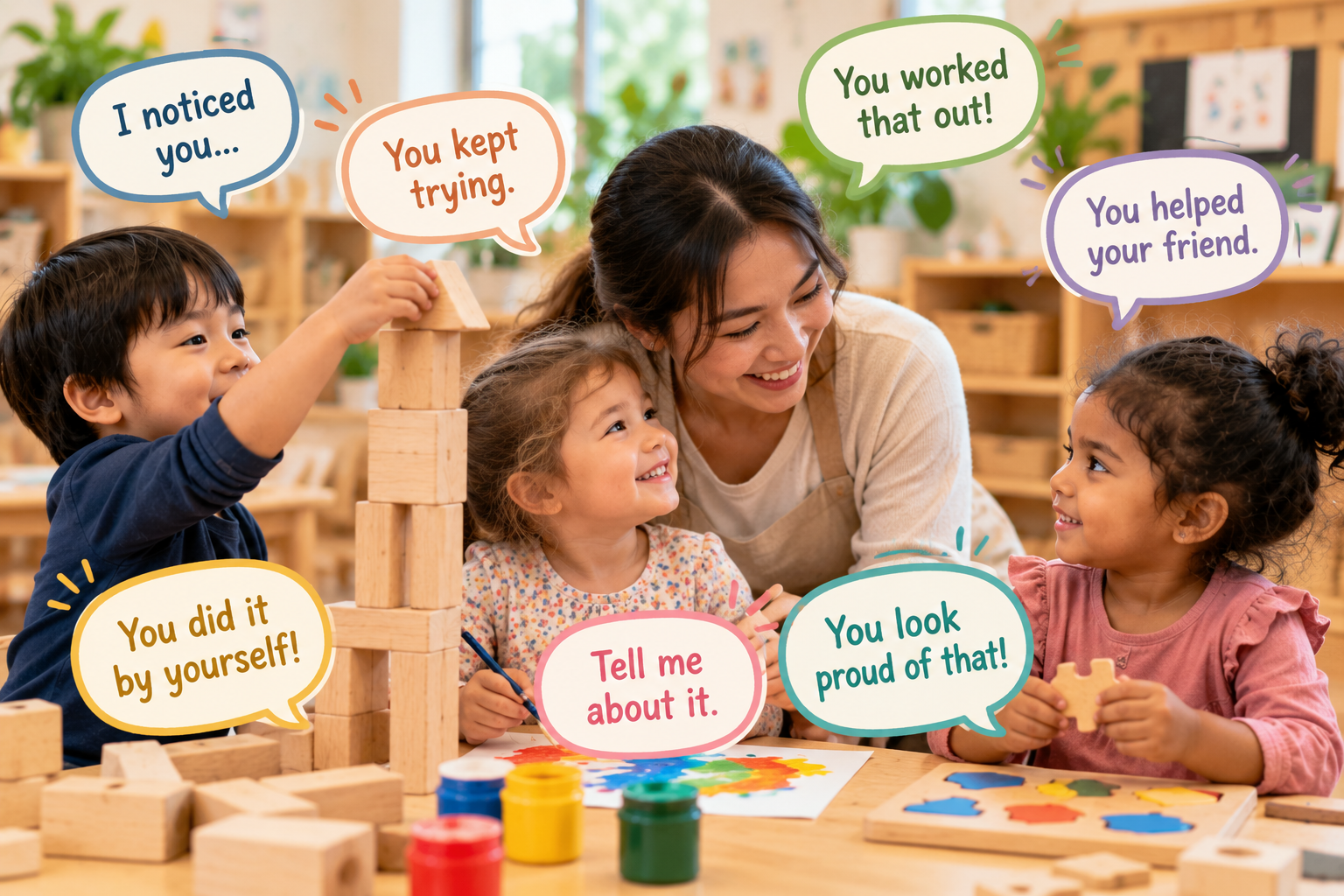
Here are 10 meaningful alternatives to “good job” for preschool teachers that you can start using during everyday classroom moments.
Why Say Something Other Than “Good Job”?
Before we get to the phrases, there’s an important distinction.
The goal isn’t to remove encouragement from our classrooms.
And it certainly isn’t to make our responses cold or emotionless.
The goal is simply to make our encouragement more specific and meaningful when we can.
Instead of always evaluating what a child has done—
“That’s good.”
—we can sometimes describe what we noticed:
“You carried all those blocks back to the shelf.”
We can acknowledge effort:
“That was difficult, but you kept trying.”
We can notice feelings:
“You look really proud of that.”
Or we can invite children to think about their own work:
“How did you figure that out?”
NAEYC similarly recommends acknowledging what children do, encouraging persistence and effort, and providing specific feedback rather than relying only on general comments. NAEYC
Here are some simple ways this can sound in a real preschool classroom.
1. “I Noticed…”
This might be one of the easiest replacements for “good job.”
Simply describe something you genuinely noticed.
“I noticed you put all the puzzle pieces back when you finished.”
“I noticed you waited until Maya finished with the truck.”
“I noticed you used three different colours in your painting.”
There’s no need to exaggerate or evaluate.
You’re simply communicating:
I saw what you did.
And sometimes being genuinely noticed is powerful enough.
Teacher tip: Try completing the sentence “I noticed you…” without adding “…good job!” afterwards.
2. “You Kept Trying.”
Think about the child trying to zip their jacket.
Or balance a block tower.
Or fit a puzzle piece.
Or put on their own shoes.
Our instinct might be to celebrate the finished result:
“Yay! Good job!”

But there’s another part of the story worth noticing:
They didn’t give up.
Try:
“That was tricky, but you kept trying.”
or:
“It didn’t work the first time, so you tried another way.”
Now we’re drawing attention to persistence rather than only whether the child succeeded.
NAEYC’s guidance on mastery motivation similarly recommends praising the problem-solving process and encouraging children to persist with challenging experiences. NAEYC
3. “You Did It by Yourself.”
Preschoolers work hard toward independence.
Putting on shoes.
Pouring water.
Opening a lunchbox.
Washing hands.
Packing away belongings.
When a child finally manages something independently, instead of automatically saying:
“Good job!”
try:
“You did it by yourself!”
Or be even more specific:
“You pulled your socks on all by yourself.”
“You remembered where your bag belongs.”
“You poured the water into your cup without my help.”
You’re helping the child notice their own growing capability.
And their face will often tell you that they already know how big that achievement feels.
4. “You Worked That Out.”
Sometimes the most interesting part of children’s play isn’t what they create.
It’s how they solve the problem along the way.
Imagine a child building a bridge.
It collapses.
They rebuild it.
It collapses again.
They change the blocks underneath.
This time it stays standing.
Instead of:
“Good job building your bridge!”
try:
“You worked out how to make it stay up.”
Or:
“You changed the blocks underneath and that made it stronger.”
We’re directing attention toward their thinking.
Giving children space to solve problems is also an important part of play-based learning in preschool, where teachers can observe, respond and extend children’s thinking without taking over their play.
That can be especially useful during block play, puzzles, construction, loose-parts exploration and other open-ended experiences.
5. “You Helped Your Friend.”
Specific feedback isn’t only useful for learning activities.
It can also help us notice children’s social actions.
Maybe a child:
helps someone put on a jacket,
brings a tissue to a crying friend,
makes room at the table,
helps pack away,
or finds another child’s water bottle.
Instead of:
“Good job helping!”
try:
“You helped Noah find his shoes.”
“You moved over so your friend had somewhere to sit.”
“You saw that she was upset and brought her teddy.”
This helps make the action visible.
NAEYC notes that specific positive feedback can help children understand what appropriate social behaviour looks like. NAEYC
6. “You Look Proud of That.”
Sometimes we don’t actually need to tell children how they should feel about their work.
Their expression already tells us.
A child finishes a difficult puzzle and looks at you with the biggest smile.
Try:
“You look proud of yourself.”
Or:
“You have a big smile. You seem really pleased with what you made.”
This shifts some of the attention away from:
Does my teacher think this is good?
and toward:
How do I feel about what I did?
We can celebrate with children while still giving them space to recognise their own sense of accomplishment.
7. “Tell Me About It.”
A child walks over holding a painting.
You look at it.
You have absolutely no idea what it is.
We’ve all been there. 😅

Instead of guessing—
“What a beautiful… dinosaur?”
—try:
“Tell me about your picture.”
You might discover that the blue swirl you thought was a dinosaur is actually Grandma driving a rocket to the supermarket.
And suddenly you’ve opened a conversation rather than simply evaluating the artwork.
This works beautifully with:
paintings,
drawings,
block constructions,
playdough creations,
loose-parts designs,
and imaginative play.
This approach works particularly well during process art experiences, where children’s choices and exploration matter more than creating an identical finished product.
NAEYC includes prompts such as “Tell me more about…” among its suggestions for providing children with richer feedback. NAEYC
8. “You Used a Different Way.”
Children don’t always solve problems the way we expect.
That’s often a good thing.
Maybe everyone else carries the blocks one at a time while one child puts several blocks into a basket and carries the basket.
Maybe a puzzle piece doesn’t fit, so the child rotates the whole puzzle board.
Maybe they discover an entirely different way to attach two materials.
Try:
“You found another way to do it.”
“That didn’t work, so you tried something different.”
“You had another idea.”
We’re acknowledging flexible thinking rather than only celebrating the finished result.
And we don’t necessarily need to immediately show children the “right” way.
Sometimes the experimenting is the learning.
9. “Thank You for Helping.”
Not every positive interaction needs to be praise.
Sometimes a genuine thank you makes more sense.
Instead of:
“Good job cleaning the table!”
try:
“Thank you for helping me wipe the table.”
Instead of:
“Good job packing away!”
try:
“Thank you for putting the blocks back where they belong.”
It sounds like a small difference, but now we’re communicating appreciation rather than rating the child’s performance.
It can also model the kind of respectful language we’d like children to use with one another.
10. Sometimes, Don’t Say Anything
This one can feel strange at first.
But we don’t need to comment on everything children do.
Imagine a child concentrating deeply on building.
They add one block.
Adjust another.
Step back.
Look carefully.
Try again.
Do we need to interrupt with:
“Wow! Amazing! Good job!”
Maybe not.
Sometimes we can simply smile.
Nod.
Sit nearby.
Offer a thumbs-up.
Or allow the child to continue concentrating.
NAEYC includes nonverbal acknowledgement—such as a smile or gesture—as another way adults can communicate that they notice children’s learning. NAEYC
Our attention can communicate plenty without turning every accomplishment into an adult evaluation.
What Can I Say Instead of “Good Job”?
If you’re standing in your classroom tomorrow and your brain suddenly goes blank, you don’t need to remember ten different phrases.
Remember these four:
Notice it.
“I noticed you…”
Describe it.
“You put all the pieces back on the shelf.”
Acknowledge the effort.
“You kept trying.”
Invite reflection.
“How did you work that out?”
That’s enough.
You don’t need the perfect teacher phrase every time.
And Yes—You Can Still Say “Good Job!”
This deserves its own section.
Because after reading articles about praise, teachers can sometimes leave thinking:
Oh no. I’ve been saying “good job” all day. Have I been doing everything wrong?
No.
We’re human.
“Good job!” will probably still come out of our mouths sometimes—especially when we’re excited for a child.
And that’s okay.
NAEYC’s own guidance on alternatives to “good job” explicitly says that saying it now and then is fine; the issue is that generic praise alone doesn’t give children much information about why what they did was successful or meaningful. NAEYC
So this isn’t about banning two words from the classroom.
It’s about expanding our teacher language.
Instead of having one automatic response, we have more choices.
Sometimes:
“Good job!”
Sometimes:
“You kept trying.”
Sometimes:
“Tell me about it.”
And sometimes:
A smile.
The goal isn’t perfect teacher language.
It’s more intentional teacher language.
A Little Challenge for Tomorrow
Here’s something simple to try.
Don’t attempt to stop saying “good job” for the entire day.
Instead, choose one part of your routine.
Maybe morning play.
Art.
Outdoor play.
Or lunchtime.
Whenever you notice yourself about to say:
“Good job!”
pause for one second and ask:
What did I actually notice?
Then say that instead.
“You carried that carefully.”
“You waited for your turn.”
“You tried again.”
“You remembered.”
“You helped.”
“You worked it out.”
That tiny pause can completely change the conversation.
And after a while, you may find that these responses begin to come naturally.
Meaningful Feedback Doesn’t Need to Be Complicated
Young children don’t need us to narrate or praise every moment of their day.
They need teachers who are present enough to notice what they’re doing, thoughtful enough to recognise the learning underneath it, and warm enough to let them know that their efforts matter.
Sometimes that will sound like:
“Good job!”
And sometimes it might sound like:
“I saw how hard you worked on that.”
The difference isn’t about finding the perfect phrase.
It’s about making our words genuine, specific and connected to the child in front of us.
Looking for More Preschool Teaching Ideas?
Meaningful feedback is just one part of creating a classroom where children feel confident to explore, solve problems and develop their own ideas.
If you’d like to explore this further, read What Is Play-Based Learning? 7 Simple Ways to Support It in Preschool next.
You’ll find practical ways to support children’s learning through your classroom environment, materials, observations and everyday interactions—without taking over their play.
Leave a Reply